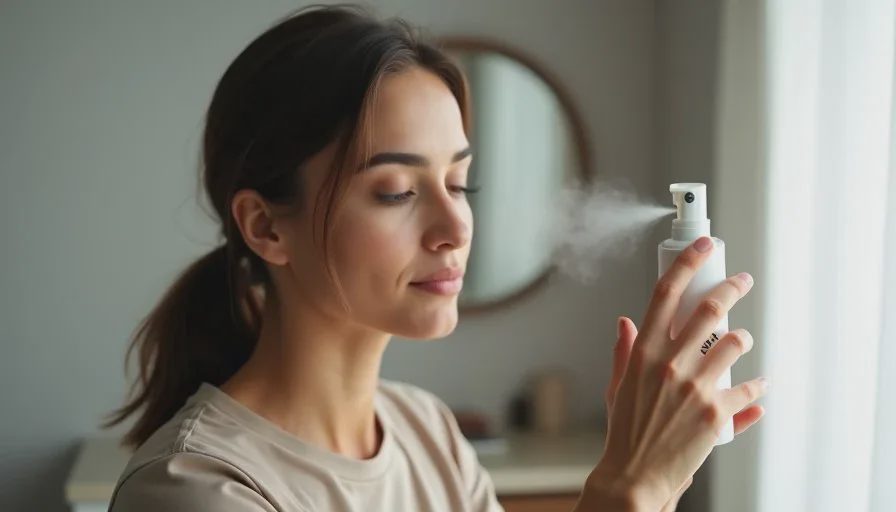
Setting spray is often presented as the final step that locks makeup in place for hours. Some formulas do improve wear. Others mainly deliver a temporary wet sensation and leave little lasting difference by mid-afternoon. The gap between the claim and the result is especially noticeable under office conditions—fluorescent lighting, dry air, and a full day of normal movement.
I wore several setting sprays through regular workdays to watch what actually changed. I was not looking for all-day perfection. I wanted to know which ones made a visible or tactile difference in how foundation, concealer, and cream products held up, and which ones simply felt damp for a few minutes before disappearing.
How I Tested
I applied each setting spray over the same basic routine: moisturizer, a light skin tint or sheer foundation, thin concealer, and cream blush. I sprayed according to the usual instructions—arms-length distance, light mist, allowing a moment to dry. I did not add extra powder unless the spray itself felt sticky enough to need it.
I worked normal days that included computer time, conversations, coffee, and typical face-touching. I checked the makeup at mid-morning, after lunch, and around 6 p.m., paying attention to:
Whether creasing under the eyes was reduced
Whether cream blush and skin tint stayed more even
Whether the finish looked more coherent or simply shinier
How the skin felt after the initial wetness faded
The formulas I tested represented common types: a hydrating mist-style spray, a more traditional hold-focused spray, a dewy-finish spray, and a lightweight all-day claim spray.
What I Observed
Immediate Sensation
Almost every setting spray produced an initial wet or cool feeling. That sensation is part of why the category feels effective in the moment. The useful question is what remains after the wetness evaporates.
Some sprays left the skin feeling slightly tacky for several minutes. Others dried to a neutral finish. A few left a noticeable film that made cream products feel less blended until it settled.
Mid-Morning Check
By late morning the differences were still modest. The hold-focused spray seemed to keep the under-eye area slightly smoother. The hydrating mist made the skin feel comfortable but did not obviously change how the makeup sat. The dewy spray maintained a bit more luminosity, which under office lighting sometimes read as freshness and sometimes as excess shine depending on the day.
After-Lunch and End-of-Day Results
This was where the practical value became clearer.
The sprays that mainly delivered a wet feeling at application showed little lasting advantage by early afternoon. Makeup faded and creased at roughly the same rate it did on days without spray. The initial sensation had been pleasant; the measurable help was minimal.
The hold-focused formulas produced a more noticeable difference in the under-eye area and along the sides of the nose—places where sheer base products often settle first. Creasing was not eliminated, but it appeared later and looked less pronounced.
The dewy-finish sprays kept a softer overall look longer on some days, yet in dry office air they sometimes emphasized texture by late afternoon as the moisture balance shifted.
The lightweight “all-day” sprays varied. Some behaved like milder versions of the hold-focused category. Others performed closer to the hydrating mists—comfortable at first, limited impact later.
Why Some Sprays Help and Others Mostly Feel Wet
Film Formers Versus Simple Mists
Sprays that improve wear usually contain ingredients that form a light film over the makeup. That film can slow down the movement of product into fine lines and reduce transfer from light touching. Simple hydrating mists primarily add water and humectants. They feel good and can make the skin look briefly fresher, but they do not create the same barrier.
Interaction with Dry Office Air
Air conditioning and heating pull moisture from both skin and product. A spray that relies on a dewy, water-heavy finish can lose its advantage once that moisture evaporates. A spray that leaves a flexible, light film tends to keep its effect longer in the same environment.
How Much Product Is Already on the Face
Setting spray behaves differently over a very sheer routine than over a more layered one. On the light skin-tint days I tested, the benefit of even a good hold spray was modest. On days when I used slightly more concealer or cream products, the same spray made a clearer difference. The spray is not magic; it works with what is already there.
Practical Takeaways for Workdays
If Your Main Problem Is Creasing
A hold-focused setting spray is more likely to help than a purely hydrating mist. Apply it lightly after the rest of the makeup is done and give it a real minute to dry before touching your face. Heavy application rarely improves results and can leave a sticky feeling.
If Your Main Problem Is Dryness or Tightness
A hydrating mist can make the morning more comfortable and give a temporary refreshed look. Do not expect it to significantly extend the wear of base products. Treat it as a comfort step rather than a longevity step.
If You Want a Soft Finish Without Extra Shine
Look for sprays that dry to a natural rather than dewy finish. Under fluorescent lights, persistent dewiness can sometimes cross into looking oily by mid-afternoon, especially in warmer offices.
Less Is Usually More
A light, even mist performed better in my tests than repeated heavy sprays. Too much product can disrupt cream blush or leave the face feeling coated.
How I Use Setting Spray Now
I do not reach for setting spray every day. On ordinary desk days with a very light routine, I often skip it. On days when I am wearing slightly more concealer, when the office air is especially dry, or when I know I will be in back-to-back meetings with limited chance to check a mirror, I use a hold-focused spray lightly.
I treat it as a supporting step rather than a guarantee. It can improve the odds that makeup stays coherent longer. It does not replace good shade matching, thin application, or realistic expectations about fade.

A Simple Way to Test Your Own Setting Spray
Apply your usual makeup on two comparable workdays. Use the setting spray on one day and skip it on the other. Check the same areas—under the eyes, around the nose, the cheeks—at lunch and again before you leave. Notice whether creasing, fading, or overall coherence actually differ.
The wet feeling at application is easy to notice. The lasting difference is the only thing that matters for deciding whether the product earns its place in a workday routine.
Final Notes
Some setting sprays help. They form a light film that slows creasing and keeps sheer makeup looking more even for longer under office conditions. Other sprays mainly feel wet for a few minutes and then leave the day to proceed as it would have without them.
The distinction is practical rather than moral. A hydrating mist is not a failure if comfort is what you wanted. A hold spray is not a success if it leaves the face sticky or shiny in a way that bothers you under fluorescent lights.
Pretty is lovely. Practical is better. And for setting spray, practical means choosing the formula that produces a visible difference in wear by late afternoon rather than the one that only delivers a convincing sensation at 8 a.m.
If a spray consistently improves how your makeup looks at 5 or 6 p.m., it is doing its job. If the main thing it delivers is the memory of feeling wet, it may be optional on most workdays.

No comments yet — be the first to share a thought.